Publication
Review in Circulation Research: single-cell studies of atherosclerosis genetics
Daniel Li and colleagues review how single-cell genomics is reshaping our understanding of the genetic and molecular basis of atherosclerosis.
New papers, new faculty, and milestones from the lab and its alumni.
Daniel Li and colleagues review how single-cell genomics is reshaping our understanding of the genetic and molecular basis of atherosclerosis.
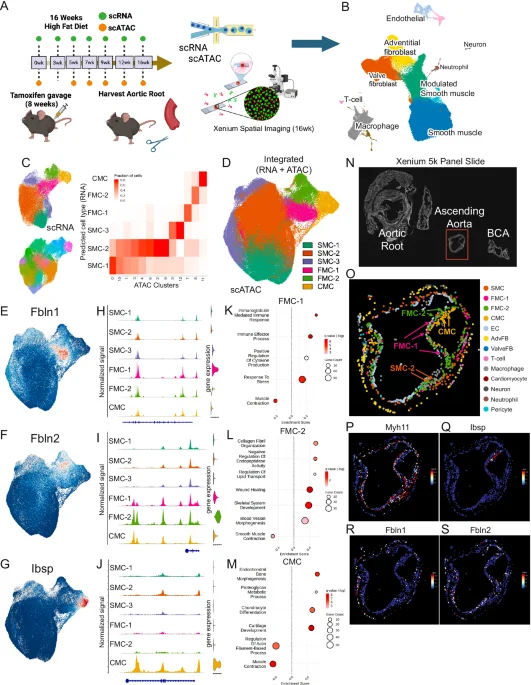
A dense single-cell RNA and chromatin timecourse of atherosclerosis maps how smooth muscle cells transition into disease-associated states, and where CAD genetic risk acts along those trajectories.
Led by Daniel Li, this study builds a timecourse single-cell transcriptomic and epigenomic map of smooth muscle cells in a mouse model of atherosclerosis, pairs it with Xenium spatial transcriptomics, and uses network-based prioritization and in silico transcription-factor perturbation to identify the regulators — including TCF21 and TEAD1 — that drive SMC cell-state changes. Integration with CAD GWAS shows that heritable risk concentrates in transitional SMC states.
Data are available on CELLxGENE and GEO (GSE321762).
In a collaboration led by the Lavine and Stitziel labs (Washington University), FAP-directed approaches target modulated vascular smooth muscle cells in atherosclerosis.
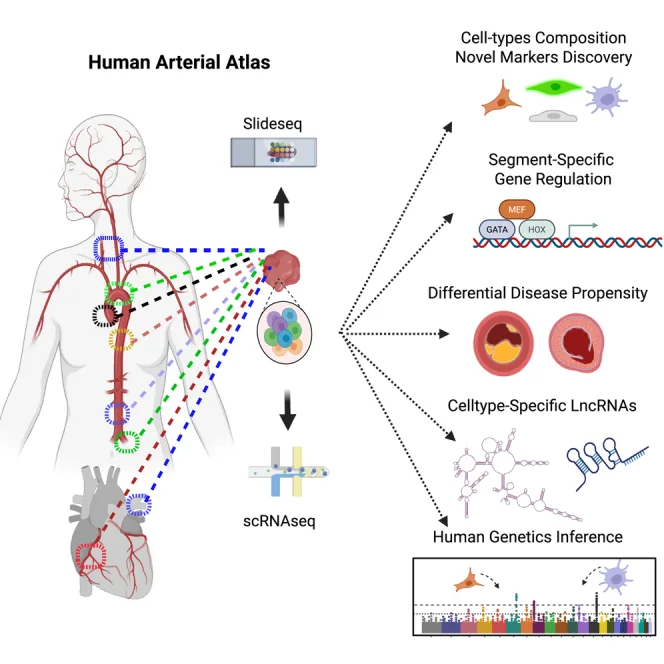
Our CZI Human Cell Atlas project profiles eight human arterial beds with single-cell and spatial transcriptomics, revealing segment-specific vascular cell programs and their links to disease genetics.
Led by Quanyi Zhao and Paul Cheng, the atlas characterizes smooth muscle cells, fibroblasts and endothelial cells across eight anatomically distinct human arteries, shows how embryonic origin shapes adult vascular identity, maps vascular disease GWAS variants onto segment-specific programs, and catalogues cell type–specific long noncoding RNAs.
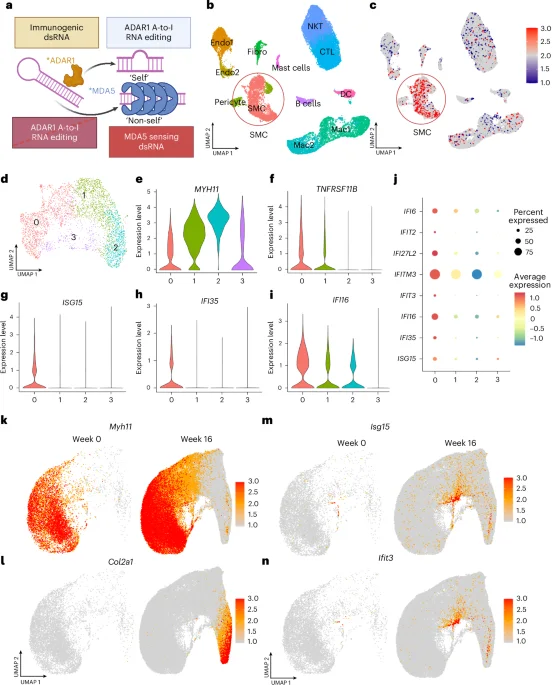
Chad Weldy and colleagues show that smooth muscle ADAR1 editing prevents activation of the double-stranded RNA sensor MDA5, linking an RNA-editing CAD pathway to plaque growth and calcification.
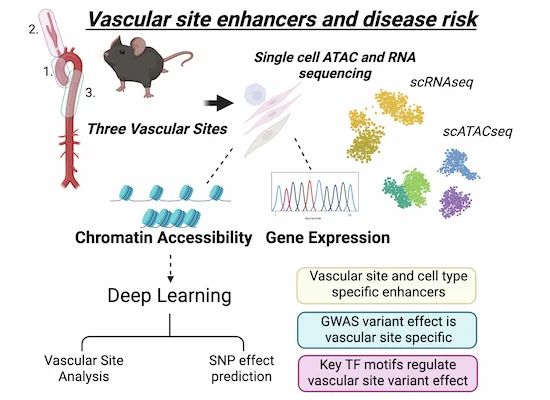
Single-cell chromatin and transcriptome maps of three vascular sites show enhancer landscapes that reflect developmental origin, with deep-learning models predicting site-specific effects of disease variants.
Markus Ramste, Chad Weldy and colleagues, with the Engreitz and Kundaje labs, report genome-scale CRISPRi screens of CAD GWAS enhancers in human coronary artery smooth muscle cells.
Paul Cheng and Tom Quertermous comment in Nature Cardiovascular Research on spatial transcriptomic mapping of coronary atherosclerosis — in the luminal plaque and beyond.
Congratulations to Chad Weldy (postdoctoral fellow 2021–2023) on his appointment to the Stanford Cardiovascular Medicine faculty. Chad now leads the Weldy Lab as Assistant Professor of Medicine.
Congratulations to Paul Cheng (postdoctoral fellow 2019–2023) on his appointment as Assistant Professor of Medicine in Cardiovascular Medicine and the Stanford Cardiovascular Institute.
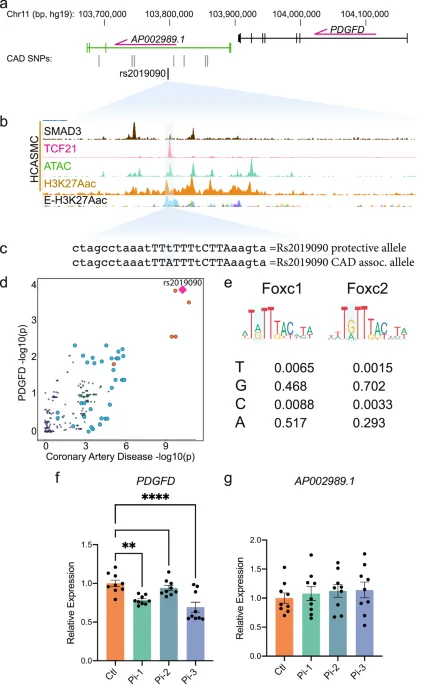
Hyun-Jung Kim and colleagues show how a FOXC1-regulated variant controls PDGFD and how PDGFD drives disease-associated smooth muscle cell states in plaque.
Congratulations to Brian Kim (postdoctoral fellow and instructor 2014–2021) on his appointment as Assistant Professor of Medicine in Cardiovascular Medicine and the CVI.
Congratulations to Rob Wirka (postdoctoral fellow 2017–2020), now Assistant Professor of Medicine and Cell Biology & Physiology at UNC School of Medicine, continuing to use human genetics to discover new CAD mechanisms.
Single-cell lineage tracing shows that smooth muscle cells modulate into protective fibromyocytes, and that the CAD gene TCF21 promotes this transition.